
Data Tech Stack 2026: Tools Beginners Need (Skip the Rest)
December 11, 2025In our last post, we figured out which character you are in the data movie: the Builder (Engineer), the Detective (Analyst), or the Predictor (Scientist).
But knowing who you are is only step one. Step two is knowing what to put in your backpack.
If you Google “data tools,” you will get a list of 50+ software names that look like alphabet soup. Hadoop? Spark? PyTorch? dbt? It’s overwhelming.
Let’s simplify it. Think of a high-end restaurant kitchen.
- The Data Engineer is the Supplier & Prep Chef (building the supply chain).
- The Data Analyst is the Head Chef (creating the menu and plating the dish).
- The Data Scientist is the Molecular Gastronomist (experimenting with new flavors).
Here is the specific toolkit or “knife set” you need for each role in 2026.

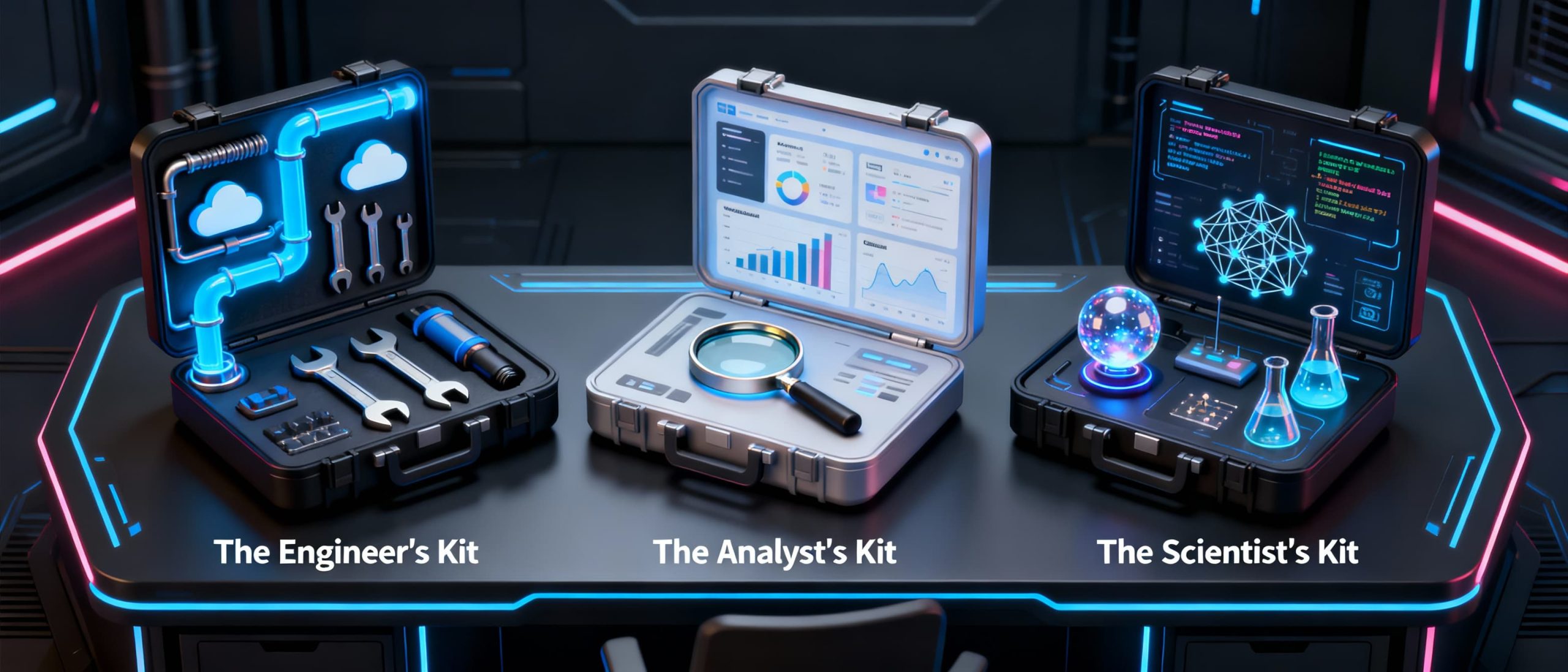
The Data Engineer’s Stack: Heavy Machinery
The Prep Chef & Supplier
Your job is to move ingredients (data) from the farm to the fridge without them rotting. You don’t need to know how to make a fancy soufflé; you need to know how to drive the delivery truck and fix the refrigerator.
- It is non-negotiable. You will use it to write scripts that move data from Point A to Point B
- 2025 Update: Focus on libraries like Polars (faster than Pandas) and PySpark for big data.
- SQL (The Universal Language): You need “Advanced SQL.” We aren’t talking about simple SELECT. We mean complex joins, window functions, and optimizing queries so they don’t crash the database.
- Cloud Platforms (The Warehouse): You cannot store Big Data on a laptop. You need to master one of the Big Three clouds: AWS(Amazon), Azure(Microsoft) or GCP(Google).
- Hot in 2025: Snowflake and Databricks are the industry standards for storing data. Knowing these is a massive resume boost.
- Orchestration (The Schedule): Tools like Apache Airflow or Mage. These are just calendars that tell the computer: “Wake up at 3 AM, download the sales data, and clean it.”
The Data Analyst’s Stack: The Plating Tools
The Head Chef
Your job is to take the ingredients the Engineer prepped and turn them into a delicious meal (insight) for the customer (CEO). You need speed and presentation.
- SQL (The Knife):
Yes, you need this too. But you use it differently. You use SQL to slice and dice the data to find answers. “Show me sales in Texas for last March.” - Excel / Google Sheets (The Cutting Board):
Don’t roll your eyes. Excel is still the #1 data tool in the world. VLOOKUP and Pivot Tables are your best friends for quick analysis. - BI Tools (The Dinner Plate):
This is how you serve the food. Tableau and Power BI allow you to build colorful dashboards.- 2025 Reality: Power BI is winning the market share war in corporate America, while Tableau is still huge in tech companies. Pick one and master it.
- Generative AI (The Sous Chef):
New for 2026! You need to know how to use ChatGPT or GitHub Copilot to write SQL queries faster. It’s not cheating; it’s efficiency.
The Data Scientist’s Stack: The Lab Equipment
The Molecular Gastronomist
Your job is to take those same ingredients and do weird, complex science experiments on them. You need precise, scientific instruments.
- Python (The Lab Bench):
Unlike the Engineer who uses Python to move data, you use it to analyze data. You live in libraries like Pandas (for organizing data) and Scikit-Learn (for basic machine learning). - Jupyter Notebooks (The Lab Notebook):
This is where you write your code and see the results instantly. It’s your digital scratchpad. - Machine Learning Frameworks (The Chemicals):
If you are building AI, you need heavy hitters like TensorFlow or PyTorch. These are the tools that let you build neural networks. - Statistics (The Recipe Book):
Not a software, but a “mental tool.” You need to understand probability, regression, and A/B testing. Using the tools without the math is like cooking without tasting.
Data Stack 2026: Cost & Setup Breakdown
| Tools | Category | Free Tier | Paid Starting | Setup Time | Best For |
|---|---|---|---|---|---|
| Snowflake | Warehouse | $400 credit | $2 per credit | 15 mins | SQL queries, dashboards |
| BigQuery | Warehouse | 1TB free/month | $6.25 per TB | 10 mins | Google ecosystem users |
| Airbyte | ETL | Community (unlimited) | $50/month | 20 mins | 300+ data connectors |
| Fivetran | ETL | 14-day trial | $120/month | 30 mins | Pre-built connectors |
| dbt Cloud | Transformation | Free | $50/month | 45 mins | SQL transformations |
| Metabase | BI Dashboard | Open source (free) | $120/month | 30 mins | Simple dashboards |
| Looker Studio | BI Dashboard | Free | Free | 20 mins | Google Sheets integration |
| Total (BigQuery Stack) | All essentials | Free for 6-12 months | $0 for beginners | 1 hour total | Zero-cost setup |
Key Tips For Your Setup
Free Tier Timeline
Most beginners stay on free tiers for 3–6 months before upgrading. BigQuery’s 1TB free query allowance lasts longest.
Setup Order
- Start with warehouse (Snowflake or BigQuery)
- Then add ETL (Airbyte)
- Finally add BI dashboard (Metabase or Looker Studio)
Real Cost Example
A beginner processing 5GB/month on Snowflake + Airbyte costs roughly $40–60/month after free credits run out.
Skip These at First
Don’t add dbt Cloud, Fivetran, or advanced BI tools yet. Add complexity only when your current stack slows you down.
Summary Checklist: What to Learn First?
If you are still deciding, here is the “Minimum Viable Stack” that applies to everyone:
- SQL: It is the one language every data person speaks. Start here.
- Basic Python: Just the fundamentals (variables, loops, functions).
- A Visualization Tool: Build one chart in Tableau or Power BI.
Once you have those three, you can branch out into the specific tools for your chosen character.
Still not sure which path is yours?
Go back and read our guide on DA vs DE vs DS: Finding Your Role to see which personality fits you best.
Or, stop guessing entirely. Book a 1:1 Mentorship Session with a senior professional from fortune 25 companies. They can review your background, answer your specific questions, and tell you exactly which toolset will get you hired fastest. Find Your Mentor Today
FAQs
1. What is a “data tech stack” in 2026?
A data tech stack is the combination of tools, platforms, and processes used to collect, store, transform, analyze, and activate data across your business. It usually spans data ingestion, storage, transformation, BI/analytics, experimentation, and orchestration, plus governance and monitoring.
2. What is the difference between a data warehouse and a data lake?
A data warehouse stores structured tables that are ready for analysis and is perfect for dashboards, metrics, and business reporting. A data lake can store any kind of raw file such as logs, images, or JSON, but querying and organizing it is more complex, so it usually makes sense later in the journey.
3. What is the difference between ETL and ELT?
In ETL you extract the data, clean and transform it first, and then load it into the final system, which can be slow for large volumes. In ELT you load the raw data into a warehouse first and then transform it there using SQL, which is simpler and scales better for most beginners.
4. Do I need Python for everything?
No, you can do most beginner work with SQL and a good dashboard tool such as Metabase or Looker Studio. Python becomes important later when you want to build machine learning models, automate complex tasks, or go beyond what SQL and dashboards can do.
5. Will these tools be outdated by 2027?
The main building blocks like warehouses, ELT tools, and BI platforms are not going away; they are just getting better over time. If you learn core concepts like SQL, modeling, and data quality, you will be able to adapt easily even if specific tool names change.
Take Control of Your Data Career Today
No fluff, No distractions, Just human-to-human mentoring to help you navigate your data career path with clarity and confidence.