
The Netflix Data Story: Data Analyst vs. Data Engineer vs. Scientist – Which Role Fits You?
December 8, 2025Picture this. It is Friday night and you just ordered a pizza. You settle into your couch, open Netflix, and see a “98% Match” recommendation for a movie you have never heard of. You click play and end up loving it.
That magical moment did not happen by accident. It was carefully engineered by three distinct professionals working behind the scenes.
If you are trying to figure out your career path in data, forget the complex job descriptions for a moment. Let’s look at how a Data Engineer, a Data Analyst, and a Data Scientist work together to save your Friday night.

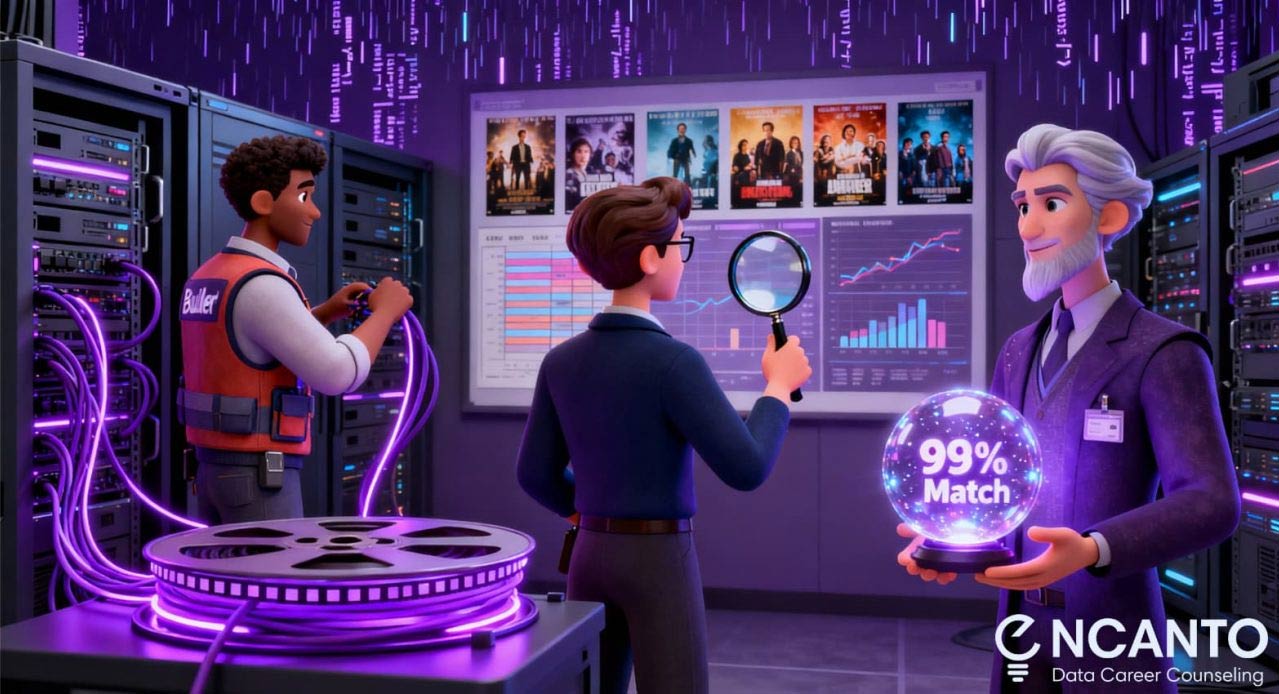
The Data Engineer: The Architect of Flow
Imagine millions of people around the world pressing play at the exact same second. That action creates a massive tsunami of information. Every pause, rewind, and skip needs to be captured instantly.
This is where the Data Engineer steps in. Think of them as the high tech plumbers or architects of the data world. They do not worry about why you watched a romantic comedy. Their only obsession is ensuring the system does not crash when a million people log in at once.
At Netflix
The Data Engineer builds the massive digital pipelines that carry this flood of data from your TV screen to the company servers. They ensure the data arrives safely, securely, and in the right format. Without them, the data would be a messy swamp that no one could use.
This role is for you if:
You love building things. You enjoy coding with languages like Python or Java and get satisfaction from making systems run efficiently. You prefer clear logic over open ended questions.
The Data Scientist: The Predictor of the Future
While the Analyst looks at the past, the Data Scientist looks at the future. They are the mathematicians and wizards of the group.
They do not just want to report on what you watched. They want to predict what you will watch next before you even know it yourself. They take the data from the Engineer and the insights from the Analyst to build complex algorithms. These are computer programs that learn and get smarter over time.
At Netflix
The Data Scientist builds the famous Recommendation Engine. They write the code that calculates the probability of you liking a sci fi movie based on the fact that you watched a documentary about space last week. They run experiments to see if changing a movie thumbnail increases the chance of you clicking on it.
This role is for you if:
You love math, statistics, and probability. You enjoy experimenting and are comfortable with failure because building a working model often takes many tries. You want to build products that feel like magic.
Comparison Table
| Feature | Data Engineer | Data Analyst | Data Scientist |
|---|---|---|---|
| Primary Archetype | The Builder | The Detective | The Visionary |
| Core Focus | Reliability and Infrastructure | Business Insights and Reporting | Predictions and Machine Learning |
| Main Tools | Python, SQL, Spark, Cloud Platforms | SQL, Excel, Tableau, Power BI | Python, R, Statistics, TensorFlow |
| Key Output | Clean and accessible data tables | Reports and visual charts | Predictive models and algorithms |
| Math Requirement | Low (Focus on Logic) | Medium (Focus on Statistics) | High (Focus on Calculus) |
The Verdict
Choosing a career comes down to what kind of problems you enjoy solving.
- Pick Data Engineering if you want to build the engine that powers the car.
- Pick Data Analytics if you want to read the dashboard and tell the driver where to go.
- Pick Data Science if you want to build the self driving feature that navigates the road automatically.
Each role is vital to the process. The only question is which character you want to play in the movie of your career.
FAQs
1. Do I need to be a math genius to become a Data Scientist?
No, but you need a solid grasp of statistics and probability. If you prefer coding logic over math, consider Data Engineering instead.
2. Does a Data Engineer need to know Machine Learning?
Not really. Data Engineers focus on building SQL and Python pipelines to move data. They support the scientists who build the actual models.
3. Can a Data Analyst eventually become a Data Scientist?
Yes, it’s a very common path. Many Analysts master SQL and business logic first, then learn Python and ML later to transition into Data Science.
4. I come from a non-tech background. Can I still work in data?
Yes! Data Analysts often come from non-tech fields because having an analytical mindset and asking the right questions is just as valuable as knowing how to code.
5. Do I need a computer science degree to be a Data Engineer?
Not strictly. Hiring managers prioritize a strong GitHub portfolio (like building a real data pipeline) over a specific university degree.
6. How do I know which data role fits my personality?
Ask yourself what you enjoy doing in your free time:
- Data Engineer: You love organizing, optimizing, and building efficient systems.
- Data Analyst: You love solving mysteries, finding patterns, and telling stories.
- Data Scientist: You love experimenting, predicting outcomes, and working with math.
- Still stuck? Book a 1:1 Mentorship Session to have an expert evaluate your skills.
Take Control of Your Data Career Today
No fluff, No distractions, Just human-to-human mentoring to help you navigate your data career path with clarity and confidence.